Hadley telescope
My build of the 3D-printed Hadley reflector, from the community’s open design.
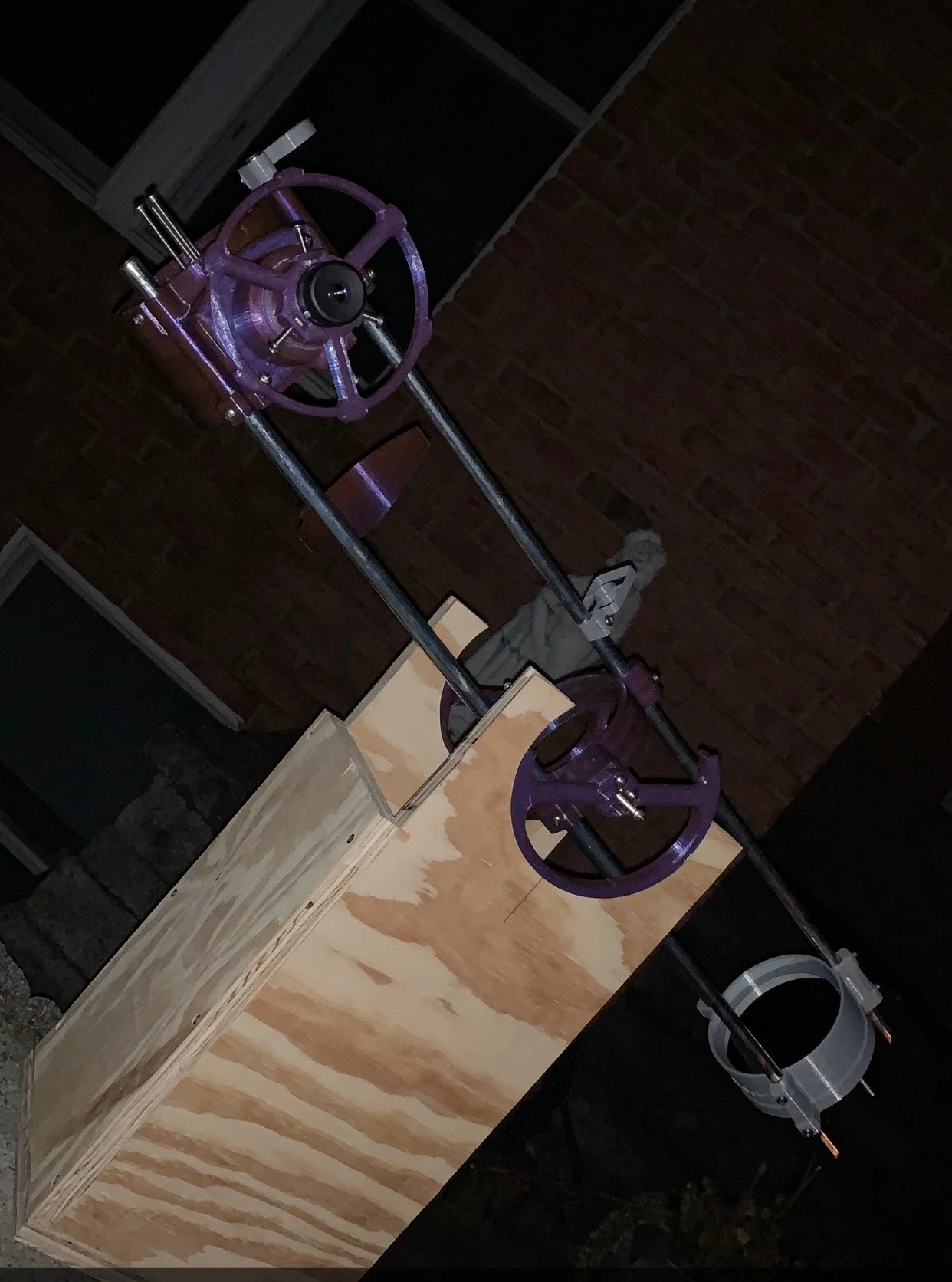
I built this telescope from Jonathan Kissner’s open Hadley design (Maff on Printables), with modifications of my own. Printed rings and three metal rods hold a 114 mm mirror with a 900 mm focal length. A small diagonal mirror sends the light out the side to the eyepiece.
Why a $20 spherical mirror is enough
A spherical mirror is easy to make, but it focuses light from its edge slightly short of light from its centre. A paraboloid fixes that and costs far more. The sphere’s error at best focus is D / (2048 N³). Keeping it under a quarter wavelength needs a focal ratio of at least ∛(D / 512λ), which is f/7.4 for a 114 mm mirror. Hadley runs at f/7.9, so the cheap sphere performs like a parabola.
Where the design comes from
Newton built the first reflecting telescope in 1668. John Hadley built the first one that worked at a useful size in 1721, and in a side-by-side test it matched the magnification and detail of the Royal Society’s 123-foot Huygens telescope. It’s the same layout as this one, three centuries earlier.